
Saturday, September 5, 2009


Doors Open Haldimand

This year, Doors Open Haldimand, focuses on the "history and heritage of the area's fertile fields." The buildings, museums and organizations reflect the active agricultural community.
On Saturday, September 19, 10 a.m. to 4 p.m. Haldimand County will open its doors in customary, friendly fashion.
For a complete list of participating sites and local maps, go to http://www.doorsopenontario.on.ca/ Visit the Haldimand County Photo Album. For more information, contact Catherine Stidsen catherine.stidsen@hwcn.org Telephone: 905-772-3790.
Photograph: Linda welcomes visitors to Grand Treats and Treasures on Cayuga St., downtown Cayuga-on-the-Grand.
Photos: by Lorna
Friday, September 4, 2009
Childhoods of Writers


A young man -- taller than the bookshelves -- declares that he has "never read a book." He seems proud.
In Negotiating With the Dead* -- a series of lectures on writing -- Margaret Atwood muses that the childhoods of writers often contain "books and solitude."
"There were no films or theatres in the North, and the radio didn't work very well," she writes. "But there were always books." Her mother liked quietness in children, and "a child who is reading is very quiet." Atwood read everything she could get her hands on.
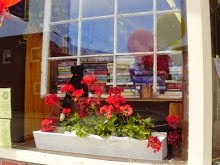
We don't know whether the young man in our store had books while growing up. We do know that when he had a book report to write, he had his mother do it for him. He told us that. We expressed shock and did our best to lure him into reading. Someday, perhaps something in our store window or more likely someone of influence will lure him back.
*Margaret Atwood, Negotiating With the Dead, A Writer on Writing, Cambridge, 2002, p 7.
Photos: by Lorna. Click on photo to view larger.
Thursday, September 3, 2009
Words of Wisdom on Writing


If we were asked what our biggest surprise has been in the used book business, it would have to be the number of published local writers there are. Poetry, prose, fiction, non-fiction. The arrival of self-publishing has made much possible.
The great short-story writer, Mavis Gallant, said, "I still do not know what impels anyone sound of mind to leave dry land and spend a lifetime describing people who do not exist. If it is child's play, an extension of make believe -- something one is frequently assured by people who write about writing -- how to account for the overriding wish to do that, just that, only that, and consider it as rational an occupation as riding a bicycle over the Alps?"*
Gallant was once asked, "Yes, but what do you really do?" ~ A question which she concludes expresses an adult opinion. She then surmises, "Perhaps a writer is, in fact, a child in disguise, with a child's lucid view of grown-ups, accurate as to atmosphere, improvising when it tries to make sense of adult behavior."
Whatever the aspiration to be an author, we encourage and love our local writers.
*Mavis Gallant, Preface, Selected Stories, McClelland & Stewart, 1996
Photos: by Lorna
Wednesday, September 2, 2009
"Seeing or Hearing Clearly and Then Transcribing"
Best-selling author, Stephen King, refers to these core ideas on good storytelling: "...that practice is invaluable (and should feel good, really not like practice at all) and that honesty is indispensable. Skills in description, dialogue, and character development all boil down to seeing or hearing clearly and then transcribing what you see or hear with equal clarity (and without using a lot of tiresome, unnecessary adverbs)." p. 195* One might add "or unnecessary adjectives."
He states that, "...good writing consists of mastering the fundamentals (vocabulary, grammar, the elements of style)" and with "hard work, dedication, and timely help," a good writer can be made out of a merely competent one. "
Stephen King also wrote, "If you don't have the time to read, you don't have the time or the tools to write."
* Stephen King, On Writing ~ A Memoir of the Craft, Scribner, 2000.
"Twist Them Up in Hard Punishment"

Seventy-eight year old, Alice Munro, has withdrawn her latest book, Too Much Happiness from running for the Giller prize this fall. Arguably, "Canada's greatest living writer" (Toronto Star, Sept. 1, Front pg.), Munro has won the prestigious Scotiabank prize twice in the past. In 1998 for The Love of a Good Woman and in 2004 for Runaway. Whatever her reasons for withdrawing, the fact remains that she has arrived at a resoundingly successful stage in her professional life.
This is a woman who wrote, "...it seemed that I had to be a writer as well as a reader. I bought a school notebook and tried to write -- did write, pages that started off authoritatively and then went dry, so that I had to tear them out and twist them up in hard punishment and put them in the garbage can. I did this over and over again until I had only the notebook cover left. Then I bought another notebook and started the whole process once more. The same cycle -- excitement and despair, excitement and despair." *
*Alice Munro, "Cortes Island" (1998) The Love of a Good Woman, p. 143.
Photos: by Lorna
Tuesday, September 1, 2009
The Blank Page


Prolific romance/suspense writer, Nora Roberts, said, "The most important thing in writing is to have written. I can always fix a bad page. I can't fix a blank one."
In a bookstore, one hears many personal theories on writing and the intimidation of the blank page.
Margaret Laurence left a husband and a home in the U.S. to live in a remote part of southern England in order to focus on her writing. The view from Robert's desk is the hills of rural Maryland. As important as the writing environment is the chosen genre. We hear, "Write what one knows."
"It is a mistake, a really big mistake," according to Roberts, "to believe that you can write what you wouldn't read for pleasure,"
And on making time, "A writer never finds the time to write. A writer makes it. If you don't have the drive, the discipline, and the desire, then you can have all the talent in the world, and you aren't going to finish a book. All the talent in the world isn't going to do you any good."
Tomorrow: More words of wisdom from writers.
Photos: by Lorna. My backyard.
Subscribe to:
Posts (Atom)