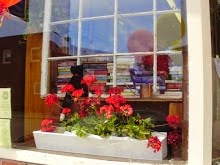
Gift-bringers vary around the world. In Canada, children wait expectantly for Santa Claus and his eight reindeer. In the Netherlands, St. Nicholas is accompanied by Zwarte Piet, or Black Peter. Black Peter tosses candy to children but also threatens to stuff bad kids into his sack and take them back with him to Spain.
I met Black Peter one time. I was taking photos for a weekly newspaper. Children were climbing all over St. Nicholas assisted by Black Peter. As I focused for the perfect shot ~ everyone smile ~ nothing happened. Had Black Peter jinxed me? Not a battery to be found. Not in my camera. Not in my bag.
My three sons and their Dad had stolen the batteries for a batteries-not-included toy and left me to explain. I did get the picture after a quick trip to the store but I have never forgotten Black Peter who is said to stuff bad kids into his sack.
Monday, December 21, 2009


Sunday, December 20, 2009
Caledonia Mill Light-Show

Multiple lights dancing, skipping, spinning ~ an amazing synchronization with music and the voices of two snowmen ~ tune in to 88.1 ~ the Christmas light-show at the old mill is worth the drive to Caledonia.
The work of Mike Montgomery and Adam Harrison, with the help of their "many elves," this is an impressive display sponsored by local businesses and community-minded individuals.
Show begins every evening at 5:30 p.m. and ends at 11:00 p.m. (Friday and Saturday 11:30 p.m.) Go to the historical Caledonia bridge on Hwy. #6. The 1800s mill can be viewed on the southwest bank of the Grand River. There is convenient parking. Turn out your lights.
Truly a tribute to the spirit of a town abandoned in many ways in recent years by all levels of government and law enforcement. Congratulations, Caledonia.
The work of Mike Montgomery and Adam Harrison, with the help of their "many elves," this is an impressive display sponsored by local businesses and community-minded individuals.
Show begins every evening at 5:30 p.m. and ends at 11:00 p.m. (Friday and Saturday 11:30 p.m.) Go to the historical Caledonia bridge on Hwy. #6. The 1800s mill can be viewed on the southwest bank of the Grand River. There is convenient parking. Turn out your lights.
Truly a tribute to the spirit of a town abandoned in many ways in recent years by all levels of government and law enforcement. Congratulations, Caledonia.
Photography by: St. Catharines', Joel Smith. For larger image, click on photo. We are indebted to Joel for sending to us the above photo. For more of Joel's work and a glimpse into the daily life of an amazing photographer, visit his website and blog at: http://www.joelsmithphotography.ca/
Peace on Earth, Good Will to Men

"The best Christmas gift one can bestow on a child or friend is a happy memory. Money cannot buy it, but it may be procured by the poorest. It can be had by a draft upon patience or a check upon ill temper, which may be changed for the coin of kind words, each bearing the imprint, 'Peace on earth, good will to men.' "
From "The New York Times," December 23, 1894.
From "The New York Times," December 23, 1894.
Photo: Courtesy of J. Walker
Friday, December 18, 2009
Soldiers' Stories

Saturday, December 19,
10:30 - 1:00.
Retired O.P.P., author Kirk Du Guid, will be signing books at The Neat Little Bookshop.
In his most recent book, Soldiers' Stories, Du Guid tells the stories of twenty-five Canadian veterans most of whom are from the Town of Haldimand.
First Cold Case is a tale of true crime in which the author and his officer partner take on a horrific unsolved murder in small-town Ontario.
Photo: by Lorna. Click on for enlarged Image
Christmas Cards
"John Meagher had to engage a horse and wagon yesterday to deliver the mails in the city," so announced the Halifax Herald on December 27, 1898. Apparently the custom of sending Christmas cards began in the Victorian era in England in the 1840s around the time when Prince Albert introduced the Christmas tree, and Dickens wrote A Christmas Carol. The first cards were handmade but by the end of the 1840s they were being marketed publicly. The scenes generally featured mistletoe and yule logs.
Canadians started making their own Christmas cards around the 1870's and often the illustrations had nothing to do with Christmas such as outdoor scenes by artists Cornelius Krieghoff and William Barlett. Religious themes and Santa Claus seldom appeared. Sleigh scenes, winter sports, children in the snow, and above all snowshoeing were popular themes and Canada by name was commonly included for folks corresponding with the old country.
By the 1880s cards were popular enough to start overloading the post office. In December 1881, the Toronto letter-carriers were often toting forty pounds of mail at a time, and extra men had to be hired to handle the Christmas rush.
Source: Canadian Christmas Book by Caroline Carver
Tundra Books of Montreal/Collins Publishers, Toronto 1975
Canadians started making their own Christmas cards around the 1870's and often the illustrations had nothing to do with Christmas such as outdoor scenes by artists Cornelius Krieghoff and William Barlett. Religious themes and Santa Claus seldom appeared. Sleigh scenes, winter sports, children in the snow, and above all snowshoeing were popular themes and Canada by name was commonly included for folks corresponding with the old country.
By the 1880s cards were popular enough to start overloading the post office. In December 1881, the Toronto letter-carriers were often toting forty pounds of mail at a time, and extra men had to be hired to handle the Christmas rush.
Source: Canadian Christmas Book by Caroline Carver
Tundra Books of Montreal/Collins Publishers, Toronto 1975
Tuesday, December 15, 2009
Good News Toronto ~ Our Everyday Heroes
We meet a lot of fascinating people in the Neat Little Bookshop. Kirk Mathieson, a Toronto-based freelance writer, came in one day in the summer and was kind enough to later send us two issues of Good News Toronto ~ Our Everyday Heroes. Stories of acts of kindness, generosity, hope and bravery fill this inspiring little newspaper.
Perhaps one letter to editor, Eva Karpati, says it best, "I was on the bus when I saw someone reading Good News Toronto. It looked very interesting. I asked her if I could have it when she finished. She passed it on to me and I read it cover to cover. This is exactly what we need because we hear too much negative news."
First of all, it is difficult to imagine strangers on a city bus chatting over a newspaper. Or perhaps this is exactly the reaction that good news can foster.
To read some of Kirk's articles and others, visit "the little paper with the big heart." Website: http://www.goodnewstoronto.ca/
Perhaps one letter to editor, Eva Karpati, says it best, "I was on the bus when I saw someone reading Good News Toronto. It looked very interesting. I asked her if I could have it when she finished. She passed it on to me and I read it cover to cover. This is exactly what we need because we hear too much negative news."
First of all, it is difficult to imagine strangers on a city bus chatting over a newspaper. Or perhaps this is exactly the reaction that good news can foster.
To read some of Kirk's articles and others, visit "the little paper with the big heart." Website: http://www.goodnewstoronto.ca/
Tuesday, December 8, 2009
Suspense Writing
In her wonderful autobiography, Kitchen Privileges, Mary Higgins Clark describes one approach to writing Suspense.
She refers to the old Hansel and Gretal tale in which Hansel dropped smooth stones and Gretel dropped breadcrumbs. The birds, of course, ate the breadcrumbs.
"The mystery/suspense writer is dropping both smooth stones and breadcrumbs. The smooth stones are ambiguous statements, never cheating the reader, but sometimes leading them astray. The breadcrumbs are the real clues to the perpetrator of the crime and the solution of the plot." Clark claims that this method of writing has never let her down.
Kitchen Privileges A Memoir by Mary Higgins Clark, Simon & Schuster, 2002.
She refers to the old Hansel and Gretal tale in which Hansel dropped smooth stones and Gretel dropped breadcrumbs. The birds, of course, ate the breadcrumbs.
"The mystery/suspense writer is dropping both smooth stones and breadcrumbs. The smooth stones are ambiguous statements, never cheating the reader, but sometimes leading them astray. The breadcrumbs are the real clues to the perpetrator of the crime and the solution of the plot." Clark claims that this method of writing has never let her down.
Kitchen Privileges A Memoir by Mary Higgins Clark, Simon & Schuster, 2002.
Subscribe to:
Posts (Atom)