Tuesday, January 27, 2015

Authors and poets write about them.   Artists sketch and paint them.  Photographers capture their beauty.

Many a tree has sheltered animals and birds, providing wildlife their homes.  Trees speak to us from a position of strength and longevity.  We played under trees as children, spend hours sitting beneath them as adults.

We plant trees to commemorate special events.  Trees comfort us when remembering lost loved ones.

The Neat Little Bookshop is launching a Favourite Tree contest in the next few weeks.  We encourage you to think about the trees that have meant something special to you and invite you to submit either a photo or a story telling how a tree, or trees, have played a part in your life.

Deadline for submissions:  May 31, 2015.
[Photo:  Cayuga Tennis Court park on the Grand.  lbw]


Find The Neat Little Bookshop on Facebook


BONNIE PEG
[First published in the Edinburgh Magazine for 1818]

As I came in by our gate end,
    As day was waxin' weary,
O wha came tripping down the street,
     But bonnie Peg, me dearie !

Her air sae sweet, an' shape complete,
    Wi' nae proportion wanting,
The Queen of Love did never move
     Wi' motion mair enchanting.

Wi' linked hands, we took the sands
     A-down you winding river ;
An', oh ! that hour an' broomy brower,
     Can I forget it ever ?

The Poetical Works of ROBERT BURNS, Walter Scott, 24 Warwick Lane, London. ["Presented to John Turnbull By a Friend, Jan 7, 1895.  Township of Seneca.]


Monday, January 26, 2015


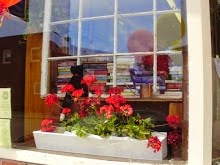
Window of The Neat Little Bookshop when we were just "a shelf" on Cayuga Street.


Winston Churchill on Hobbies ~

"To be really happy and really safe, one ought to have at least two or three hobbies, and they must all be real.  It is no use starting late in life to say:  'I will take an interest in this or that.'  Such an attempt only aggravates the strain of mental effort.  A man may acquire great knowledge of topics unconnected with his daily work, and yet hardly get any benefit or relief.  It is no use doing what you like;  you have got to like what you do.  Broadly speaking, human beings may be divided into three classes:  those who are toiled to death, those who are worried to death, and those who are bored to death . . ."

". . .to give that element of change and contrast essential to real relief ~ To restore psychic equilibrium we should call into use those parts of the mind which direct both eye and hand.  Many men have found great advantage in practicing a handicraft for pleasure.  Joinery, chemistry, book-binding, even bricklaying -- if one were interested in them and skillful at them -- would give a real relief to the over-tired brain.  But, best of all and easiest to procure are sketching and painting in all their forms. . ."
"Painting is a companion with whom one may hope to walk a great part of life's journey,
'Age cannot wither her nor custom stale
Her infinite variety.'


~ PAINTING as a pastime, The Right Honourable Winston S. Churchill, 1948, Hazell, Watson & Viney, Ltd.

Sunday, January 25, 2015


Winston Churchill former Prime Minister of the United Kingdom (Nov. 30, 1965 - Jan. 24, 1965)

     "A man can wear out a particular part of his mind by continually using it and tiring it, just the same way as he can wear out the elbows of his coat.  There is, however, this difference between the living cells of the brain and inanimate articles:  one cannot mend the frayed elbows of a coat by rubbing the sleeves or shoulders; but the tired parts of the mind can be rested and strengthened, not merely by rest, but by using other parts.  It is not enough merely to switch off the lights which play upon the main and ordinary field of interest; a new field of interest must be illuminated.  It is no use saying to the tired 'mental muscles' -- if one may coin such an expression -- 'I will give you a good rest,'  'I will go for a long walk,' or 'I will lie down and think of nothing.'  The mind keeps busy just the same.  If it has been weighing and measuring, it goes on weighing and measuring.  If it has been worrying, it goes on worrying.  It is only when new cells are called into activity, when new stars become the lords of the ascendant, that relief, repose, refreshment are afforded.
     "A gifted American psychologist has said, 'Worry is a spasm of the emotion;  the mind catches hold of something and will not let it go.'  It is useless to argue with the mind in this condition.  The stronger the will, the more futile the task.  One can only gently insinuate something else into its convulsive grasp.  And if this something else is rightly chosen, if it is really attended by the illumination of another field of interest, gradually, and often quite swiftly, the old undue grip relaxes and the process of recuperation and repair begins.

"The cultivation of a hobby and new forms of interest is therefore a policy of first importance to a public man."

[Tomorrow:  Churchill's wisdom on new interests and hobbies.]

~ Winston Churchill, PAINTING as a pastime, The Right Honourable WINSTON S. CHURCHILL O.M., C.H., M.P.  Odhams Press Limited, Ernest Benn Limited, 1948/ Hazell, Watson & Viney, Ltd.
Saturday, January 24, 2015


In EMILY CARR'S  HUNDREDS AND THOUSANDS

"Casually, you would think the world very still this morn, but really, when you consciously use your ears, there's quite a bustle and stir.  One is so lazy about life, about using our senses.  It is easier to jump into the luxurious vehicle called Drift and go nowhere particular, then wonder why we don't get anywhere.  There's smells ~ they have to fairly knock us over before we heed them.  They are such a delicate joy, and we miss three-quarters of it because we don't tune our noses in.  Fussy enough about taste because our stomachs are so demanding, we take sight for granted and only half use it, skimming along the surface.  Nor do we listen in to the silence and note all the little, wee noises like the breezes and insects.  Good heavens, the row there'd be if you could hear the footfall of all the ants!  And then there's feel.  We don't get one one-hundredth what we should out of feels.  What do we bother about the feel, the textures of things alive, and things made, and things soft, and hard, cold and hot, smooth and rough, brittle and tough, the tickle of insects, the touch of flesh, the exquisite texture of flower petals, the wind's touch, the feel of water, sleep pressing our eyelids shut  We accept all these things, that could so immeasurably add to our life, as a matter of course, without a thought, like animals do.  In fact animals seem to get more out of their senses than many people, yet we are supposed to have minds and they not."